Definition of Experienced Teachers
A teacher ceases to be a new teacher once he or she successfully completes the New Teacher Induction Program (NTIP) or, subject to any extension provided for in the regulations, his or her 24-month new teaching period has elapsed. Further details can be found in Part X.0.1 of the Education Act and O. Reg. 99/02, as amended.
Philosophy
The experienced Teacher Performance Appraisal practices should:
- support and promote the continued growth and development of experienced teachers
- foster the collaboration and relationship building that is essential to creating and sustaining a learning community in schools and
- promote a learning community culture based on sharing, trust and support.
1. Roles and Responsibilities of the Principal
Principals conduct performance appraisals of experienced teachers assigned to the school in accordance with the procedures set out in the Education Act, O. Reg. 99/02 and O. Reg. 98/02, as amended, relevant ministry guidelines, and any other requirements specified by the board that are consistent with the Act, the regulations, and any ministry guidelines.
A principal must:
- conduct performance appraisals of teachers assigned to the school such that teachers receive at least one performance appraisal every five years once they have been placed on an experienced teacher’s evaluation cycle
- within 20 school days after a teacher begins teaching in a year that is scheduled as an evaluation year for that teacher, notify him or her that the year is an evaluation year
- consider all 16 competencies in assessing the teacher’s performance
- meet with the teacher in preparation for the classroom observation
- conduct a classroom observation to appraise the teacher’s performance
- meet with the teacher after the classroom observation to review the results of the classroom observation
- as part of the post-observation meeting in an evaluation year, recommend professional growth goals and strategies for the teacher to take into account in developing his or her ALP
- prepare a summative report of the performance appraisal, using the ministry-approved form, that contains
- comments regarding the competencies
- an overall rating of the teacher’s performance
- recommendations for professional growth goals and strategies for the teacher to take into account in developing his or her ALP
- within 20 school days of the classroom observation, give the teacher written notice of his or her performance appraisal rating by providing a copy of the summative report signed by the principal
- at the request of the principal or teacher, meet with the teacher to discuss the performance appraisal after the teacher receives a copy of the summative report
- provide a copy of the summative report, signed by both the principal and teacher, to the board
- in the intervening years between appraisals, review the teacher’s ALP in consultation with the teacher and provide any feedback necessary for the teacher to update his or her plan
- at the request of the principal or teacher, meet with the teacher to discuss the teacher’s ALP in the intervening years between appraisals
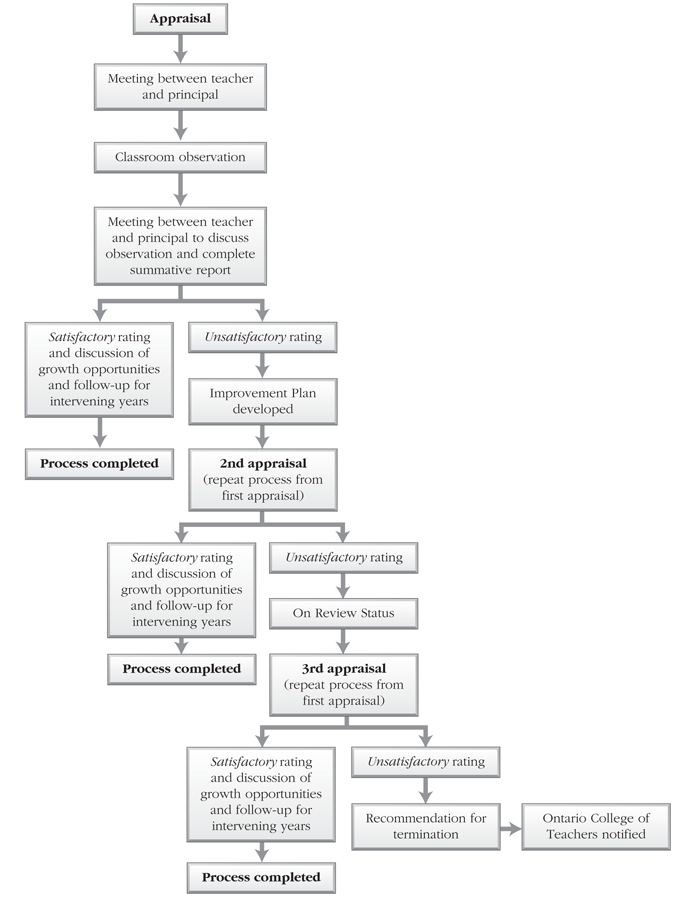
- in instances where the performance appraisal results in an unsatisfactory rating, follow additional procedures
- an improvement plan must be developed with the input of the teacher, and implemented. A subsequent TPA must be conducted and if the teacher’s performance remains unsatisfactory, he/she is placed “on review” and a third TPA is conducted. Seek support and direction from your supervisory officer in the case of a first unsatisfactory rating for any teacher.
Do not miss a deadline date in the TPA process.
2. Key Components of the Performance Appraisal Framework
The performance appraisal process for experienced teachers is intended to support and promote teacher growth and development. When the process is tied to school improvement goals and ongoing professional learning, the process becomes fully integrated into the fabric of school life.
These are the key components of the performance appraisal framework for experienced teachers:
- Competency statements to focus the appraisal on the skills, knowledge, and attitudes that reflect the standards described in the Ontario College of Teachers’ Standards of Practice for the Teaching Profession. Examples that illustrate how the competencies may be shown in practice are provided as a resource.
- An Annual Learning Plan (ALP) that provides a meaningful vehicle for teachers, in consultation with principals, to identify strategies for growth and development for the teacher’s evaluation year and for the intervening years between performance appraisals.
- Appraisals meetings that promote professional dialogue between the principal and teacher.
- A summative report to document the appraisal process, which becomes a vehicle for teachers to reflect on the feedback they receive in developing their ALP and identifying opportunities for growth. The Summative Report Form for Experienced Teachers is a ministry-approved form in accordance with the Education Act that provides a consistent approach to documenting the appraisal process.
- A rating scale to assess experienced teachers’ overall performance. The rating scale is as follows:
- Satisfactory
- Unsatisfactory
- A process for providing additional support depending on the outcome of the appraisal.
3. Performance Appraisal Process Flow Chart
4 (a). Experienced Teacher – TPA Timeline Chart (Satisfactory)
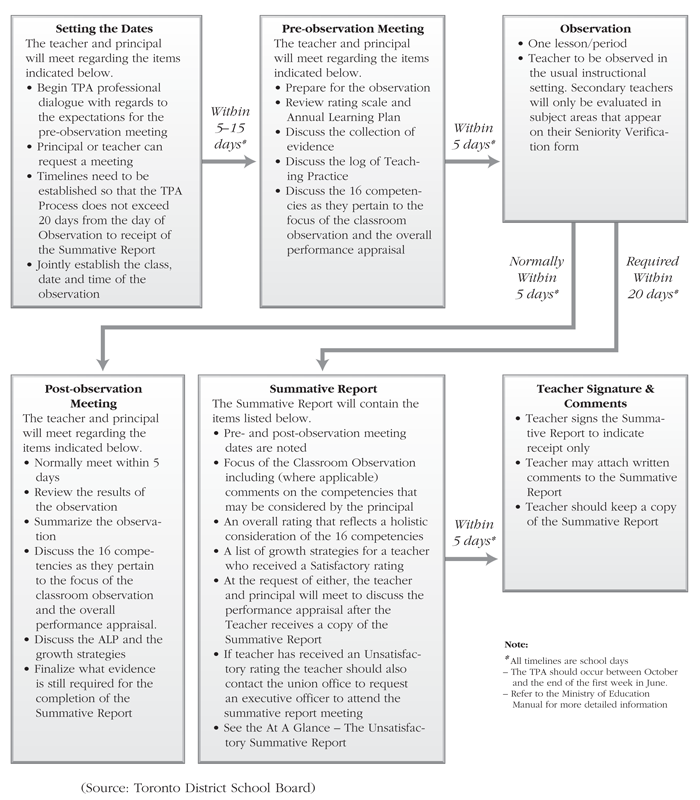
4(b). Experienced Teacher – TPA Timeline Chart (Unsatisfactory)
Note:
Under the legislation, if at any time, it is determined that a delay in appraising the teacher is not in the best interests of students, the principal and the Supervisory Officer may send a joint written recommendation to the board that the teacher’s employment should be terminated.
- Where a teacher resigns while on Review Status, the board must promptly file a complaint with the Ontario College of Teachers regarding the conduct or actions of the teacher that relate to the teacher having been placed On Review Status
- Refer to the Ministry of Education Manual for more details.
(Source: Toronto District School Board)