The Handbook for School Leaders
A Practical Guide for Principals and Vice-principals
Current Location:
Print
Table of Contents


Introduction
1. School Leadership for an Inclusive Education System
2. The Handbook for School Leaders: An Overview
3. How to Use The Handbook
4. Advice for New Principals and Vice-principals
Support for School Leaders
1. What to Do When You Need Help
2. When to Call the PST for Assistance
Ask An Expert
1. Introduction
2. Testifying as a Witness
3. Civil Liability (Lawsuits)
4. Custody and Access
Role of the Principal
1. The Principal’s Role as Described by the Ministry of Education
A. OPC Role of Principal – The Provincial Code of Conduct — (November 2008)
B. Delegation of Powers, Duties or Functions
C. OPC Role of Principal – School Councils — (November 2008)
Legal Framework
1. Hierarchical Framework of Authorities: An Overview
A. Federal
B. Provincial
C. District School Boards
D. Individual Schools: Policies, Procedures and Rules
2. Relevant Legislation: Where to Find It
3. Duties of the Principal – Education Act, Section 265
4. Role of the Principal as defined by Statute and Contract
5. Acts, Regulations and Statutes
A. Ontario and Federal
B. Policy and Program Memoranda — Ministry of Education
C. Other Related Materials
D. The Education Act: An Overview
E. Frequently Cited Regulations Made Under the Education Act
F. Regulation 298, Operation of Schools — General: An Overview
6. Discipline, Demotion, Dismissal — What Will Get You In Trouble
A. Employer Discipline (District School Board)
B. Ontario College of Teachers (OCT)
C. Provincial Offences
D. Ontario Human Rights Tribunal of Ontario — (also Employer)
E. Privacy Commission
F. Civil Court (Lawsuits) and Tribunals
Liability and Negligence in Schools
1. First Steps to Reduce Risk
A. Review Board Policies and Procedures
B. Review, Communicate and Monitor School Policies and Procedures
C. Keep Current: Resources
D. Develop the Documentation Habit
E. Encourage Staff to Keep Up-to-Date
2. Concepts and Issues: An Overview
A. Liability
B. Negligence
C. Lawsuit
D. Duty and Standard of Care
E. Risk Management
3. Duty to Provide Adequate Supervision of Pupils
A. The OPC Recommended Supervision Standards for Ontario Schools
4. Liability Insurance
A. What is It?
B. Who is Covered?
C. Conditions on Coverage
5. What to Do When a Claim Arrives
6. Resources
A. OSBIE Risk Management Calendar
B. Seminars and Conferences
C. Publications
Management Skills
1. Managerial Excellence and School Leadership: An Overview
2. Time Management
A. Getting Started
B. Setting Up Your Office
C. Your Filing System
D. Doing the Right Job at the Right Time: More Time Management Tips
E. Managing Your Email
F. Your Office Administrator
3. Delegation
A. Seven Dimensions of Delegation and Related Key Behaviours of Effective Principals
B. Four Delegation Tips
C. Dare to Delegate Checklist
4. Visibility: Management by Walking Around
A. An Overview
B. Planned Visibility: Ten Practical Tips
5. Principal’s Routines
A. A Sample of Principal’s Routines
B. A Sample Elementary School Principal’s Daily Routine
C. A Sample Secondary School Principal’s Daily Routine
6. Overview of School Year
A. Sample Checklists
B. Principal’s Checklist
Public Relations
1. Why is Public Relations Important in School Leadership?
2. Know and Understand Your School Board’s Communications Protocols
3. Create a Compelling Story, Then Share It
Media Relations and Crisis Communications
1. Media Relations
A. Things to Remember About the Media
B. Working With Reporters
C. Pitching a News Story
D. Writing a News Release
E. When Not to be Interviewed
F. There’s a Reporter on Line One – Don’t Panic
G. Create Compelling Key Messages
H. You’re on the Air
2. Crisis Communications
A. What is a Crisis?
B. Before a Crisis Hits
C. When a Crisis Hits
D. Responding to Media During a Crisis
E. In the Days Following a Crisis
Managing Conflict and Difficult People
1. The Conflict Triangle: People, Process, Situation
2. Reacting to Conflict
3. How Do You Respond to Conflict?
4. Conflict Resolution: An Overview
A. Principles of Conflict Resolution
B. Conflict Resolution: A Continuum
C. When to Use Mediation
5. Dealing with Difficult People and Complaints
A. Handling Complaints
B. Useful Responses in Difficult Situations
C. The Power of Silence
6. Relationships with Parents
A. Establishing Relationships
B. Relations With Parents — Options When Reasonableness Fails
C. Dealing with Conflict
Effective Meetings
1. Before the Meeting
A. Considerations
B. Meeting Planning Checklist
C. Sample Meeting Agendas
D. Sample Staff Meeting Template
2. During the Meeting
3. After the Meeting
Records and Information Management
1. Getting Started
2. Confidentiality and Disclosure
A. OSRs and the Courts
B. Confidential Information and the Courts
C. Confidentiality and the Duty to Report
D. Confidentiality and the Occupational Health and Safety Act
3. The Ontario Student Record (OSR)
4. Legislation Regarding Records and Information Management
A. An Overview
B. The Municipal Freedom of Information and Protection of Privacy Act
C. The Child, Youth and Family Services Act 2017 and Information Disclosure
Budget and Resource Management
1. School Budget: An Overview
A. The Education Act
B. Conflict of Interest
2. Local Financial Responsibility: The Principal’s Accountability
A. Purchasing Procedures
B. School Budget
C. Petty Cash/Cash Advance
D. Expense Reimbursement
E. Non-board Funds (Non-public Funds)
F. Audit
G. Insurance
H. Asset Control
I. Transfer of School Principal
3. Board-wide Impact: The Principal’s Role
A. Purchasing Policy
B. Hiring Part-time Staff
C. Contracts
D. Technology
E. Enrolment Reporting
F. Provincial Funding Model
4. Tips Regarding Budget and Resource Management
5. School Budget Cycle (Sample)
6. School Budget Priorities (Checklist)
Technology
1. Getting Started
A. Getting Oriented in Your New School
B. Technology Inventory
C. Further Considerations for Getting Started
2. Technology and School Administration
A. Using the Internet to Assist You with Your Job
3. Technology and the Curriculum
A. The Role of Technology in the Curriculum: An Overview
B. The Ontario Curriculum Unit Planner
C. e-Learning
D. Internet Safety: A List of Websites
E. Use of Copyright-Protected Works for Education
4. Building the School Technology Plan
A. Ten Essential Elements for Developing an Effective Technology Plan
B. Building Your School Technology Plan: A Starting Point
School Councils
1. Preparing to Work with Your School Council
A. Review Current Legislation, Policies and Additional Documentation
B. Gather Further Information
2. Working with the School Council
A. Getting Under Way
B. Considering Other Issues
C. Finding a Focus
D. Soliciting Views of School Council
3. School Councils and the Role of the Principal
A. Roles and Responsibilities of School Council Members: The Principal
B. The School Council’s Role in the Selection and Placement of Principals
4. Effective School Councils
A. Characteristics of Effective School Councils
B. What if Disputes Arise Between Members of the School Council?
C. School Councils and Confidentiality
D. Tips for Successful School Council Meetings
School Activities and Field Trips
1. School Activities and Special Events
A. An Overview
B. School Activities and Field Trips: Getting Started
C. Planning and Organization of a Field Trip or Co-Instructional Program
D. Fundraising
E. Assemblies and Special Events (Daytime)
F. Dances and Special Events (Evenings and Weekends)
2. Field Trips
A. Preparation
B. Authorization
C. Supervision
D. Costs
E. Transportation
Labour Relations, Employment Law and Terms and Conditions of Employment
1. Labour Relations and Contract Negotiation
A. Managing in a Unionized Environment
B. The Management Team
C. Progressive Discipline
D. Performance Appraisal
E. Grievances
F. In the Event of Job Action
2. Basic Principles of Employment Law
3. Workplace Investigation
4. Principal/Vice-Principal as the Respondent
A. Overview
B. Investigation Procedure
C. Interview with the Investigator
5. Terms and Conditions of Employment for Principals and Vice-Principals
A. Overview
B. The Right to Negotiate under the Charter 
C. Good Faith Negotiations 
D. Negotiated Provisions 
The Ontario College of Teachers
1. Investigation of Complaints by the Ontario College of Teachers
A. What to do Do if a Complaint is Made Against You to the College
B. When a Member of the Public Has Concerns About a Teacher
C. Members' Rights During an Investigation
2. Professional Advisories
3. Ethical Standards for the Teaching Profession
4. Standards of Practice for the Teaching Profession
5. Professional Learning Framework for the Teaching Profession
6. Publications and Documents
7. Margaret Wilson Library
Special Education
1. Special Education Legislation and Policy Direction
A. The Education Act on Special Education
B. Special Education Regulations
C. Special Education: Ontario Ministry Documents — Realizing the Promise of Diversity: Equity and Inclusive Education Strategy (2009)
D. Policy/Program Memoranda
E. Resource Documents
F. Related Information
G. Roles and Responsibilities: Principal, Teacher, Special Education Teacher, Parent/Guardian and Student
2. Special Education: Getting Started
A. Board Documents
B. School Based Teams
3. Identification Placement Review Committee (IPRC)
A. An Overview
B. The IPRC Timeline
4. Individual Education Plan (IEP)
A. An Overview
B. The IEP Process: An Overview
5. Human Rights Legislation, Policies and Proceedings
A. Human Rights Code, R.S.O. C.22
B. Guidelines on Accessible Education
C. Human Rights Tribunal of Ontario
6. Learning for All K-12 (Draft Document)
A. Our Shared Beliefs
B. The Breakthrough Systems
C. Instructional Approaches
D. The Tiered Approach
Supervision of Staff Performance and Behaviour
1. Getting Started
A. Definitions and Documents
B. Collective Agreements
2. Supervision of Vice-principals
3. Teacher Performance Appraisal (TPA)
A. Legal Framework
B. Teacher Performance Appraisal Framework (Experienced and New Teacher)
C. Annual Learning Plan (ALP)
D. Experienced Teacher TPA
E. New Teacher Induction Program (NTIP) - Teacher Performance Appraisal
F. A Year-Long Approach to the Teacher Performance Appraisal Process
4. Supervision of Behaviour
A. Progressive Discipline
B. Inappropriate or Unacceptable Behaviour
C. Insubordination
D. Professional Misconduct
E. Dismissal
F. Guidelines for Administrators
Safe and Accepting Schools: Understanding your responsibilities - New
1. What You Need to Know
A. Requirements
B. Progressive Discipline
C. Suspension
D. Expulsion
E. Progressive Discipline/Mitigating Factors Checklist
F. Employee Responsibility to Report and Principal Duty to Investigate
G. Notification of Students Harmed
H. Safe Schools Incident Reporting Form
I. Search and Seizure
J. Event Protocol
K. Police/School Board Protocol
L. Access to School Premises: Regulation 474/00
2. What’s Nice to Know:
A. Ongoing updates to requirements regarding Safe and Accepting Schools.
B. Progressive Discipline Policies
C. Effective Documentation Checklist
D. Codes of Conduct
E. School Attendance
F. Dress Codes
3. Want to Know More?
Protecting Students at Risk
1. Reporting Child Abuse
A. Overview of Duty to Report
B. Allegations of Abuse by a Staff Member
2. Allegations of Discrimination
A. A Principal's Duty
3. Bullying
A. What is Bullying?
B. Prevention of Bullying
C. Bullying Prevention and Intervention: Role of Boards
D. Bullying Prevention and Intervention: Role of Schools
E. Duties of the Principal
F. Suspension and Expulsion for Bullying
4. Cyberbullying
A. An Overview
B. Principal's Role
C. Bullying of Principals — What To Do When It's You
Occupational Health and Safety
1. Duties of the Principal
2. Conducting a School Safety Inspection
3. Developing Occupational Health and Safety Procedures
4. Health and Safety Work Refusal
5. Workplace Violence
6. Resources
Emergency Preparedness
1. Getting Started
2. Preventive Measures
A. Emergency Response Commitee
B. Emergency Response Plan
C. Crisis Communication Response Plan
D. Equipment and Information
E. Evacuations, Lockdowns and Other Emergency Responses
3. Guiding Principles in Emergencies
A. Take Control
B. Call for Emergency Assistance
C. Communicate, Communicate, Communicate
D. Checklist of Immediate Action in Emergencies
E. Emergency Call Sequence - The Eight Steps
F. Principal 911 - Contact Checklist Review
G. Lockdown Procedure Guidelines
4. Follow-up and Evaluation
Student Medical Needs
1. Getting Started
A. Board Policies and Procedures and School Practices
B. Individual Student Needs
C. Prevention Programs
2. Responding to Specific Situations
A. Anaphylaxis: Allergies and Emergency Medical Treatment
B. Sabrina's Law
C. Ryan’s Law-Ensuring Asthma Friendly Schools
D. Administration of Medication to Students
E. Accidents and Injuries
3. Other Health Issues
A. Chronic Illness
B. Smoking
C. Immunization
D. Communicable and Infectious Diseases
4. A Comprehensive School Health Program
A. Social/Medical/Physical Support
B. Preventive Health
Print
Recently Changed Content

Book Structure Changed Documents


Part 0 — Introduction
Introduction
Support for School Leaders
Ask An Expert
Role of the Principal
Legal Framework
Liability and Negligence in Schools
Management Skills
Public Relations
Media Relations and Crisis Communications
Managing Conflict and Difficult People
Effective Meetings
Records and Information Management
Budget and Resource Management
Technology
School Councils
School Activities and Field Trips
Labour Relations, Employment Law and Terms and Conditions of Employment
The Ontario College of Teachers
Special Education
Supervision of Staff Performance and Behaviour
Safe and Accepting Schools: Understanding your responsibilities - New
Protecting Students at Risk
Occupational Health and Safety
Emergency Preparedness
Student Medical Needs
Search:
Keywords:
New Teacher Induction Program (NTIP) - Teacher Performance Appraisal Last Updated: 2012-06-15

Definition of New Teachers

For purposes of the New Teacher Induction Program, including the performance appraisal process for new teachers, new teachers are defined as all teachers certified by the Ontario College of Teachers (including teachers trained out-of-province) who have been hired into permanent positions – full time or part time – by a school board, school authority, or provincial school (“board”) to begin teaching for the first time in Ontario. Teachers are considered “new” until they successfully complete the New Teacher Induction Program or when 24 months have elapsed since the date on which they first began to teach for a board (refer to section 267 (2) of the Act).

Philosophy

The New Teacher Performance appraisal practices should:

  • support and promote the continued growth and development of new teachers
  • foster the collaboration and relationship building that is essential to create and sustain a professional learning community in schools
  • promote a professional learning community culture based on sharing, trust and support.

Overview of Performance Appraisal Steps

In accordance with the regulation, the following procedures are always to be followed:

  • a pre-observation meeting
  • classroom observation
  • a post-observation meeting
  • completion of the Summative Report Form for New Teachers, including a rating of the teacher’s overall performance.

In instances where a teacher’s performance appraisal results in a Development Needed or an Unsatisfactory rating, additional procedures are required. For details, refer to Ministry of Education New Teacher Induction Program.

1. Roles and Responsibilities of the Principal

The roles and responsibilities of a principal could be assumed by a vice-principal of the same school, or a supervisory officer, in instances where those responsibilities are delegated under Part X.2 of the Education Act:

  • meet with the new teacher in preparation for the classroom observation of the teacher
  • conduct a classroom observation to assess the teacher’s performance in relation to the competencies
  • meet with the new teacher after the classroom observation to review the results of the classroom observation and discuss other information relevant to the appraisal of the teacher’s performance, including parental and student input concerning the teacher and the teacher’s participation in the New Teacher Induction Program
  • prepare a Summative Report of the performance appraisal, using the approved form, containing the appraisal of the teacher’s performance in relation to the competencies, an indication of whether the teacher participated in the New Teacher Induction Program, the overall rating of the teacher’s performance in accordance with the rating scale for new teachers set out in O. Reg. 99/02, as amended, and growth strategies for the teacher’s further development
  • provide the teacher with a copy of the signed Summative Report within 20 school days after the classroom observation
  • at the request of the principal or teacher, meet with the teacher to discuss the performance appraisal after the teacher receives a copy of the Summative Report
  • provide a copy of the Summative Report signed by both the principal and the teacher to the board.

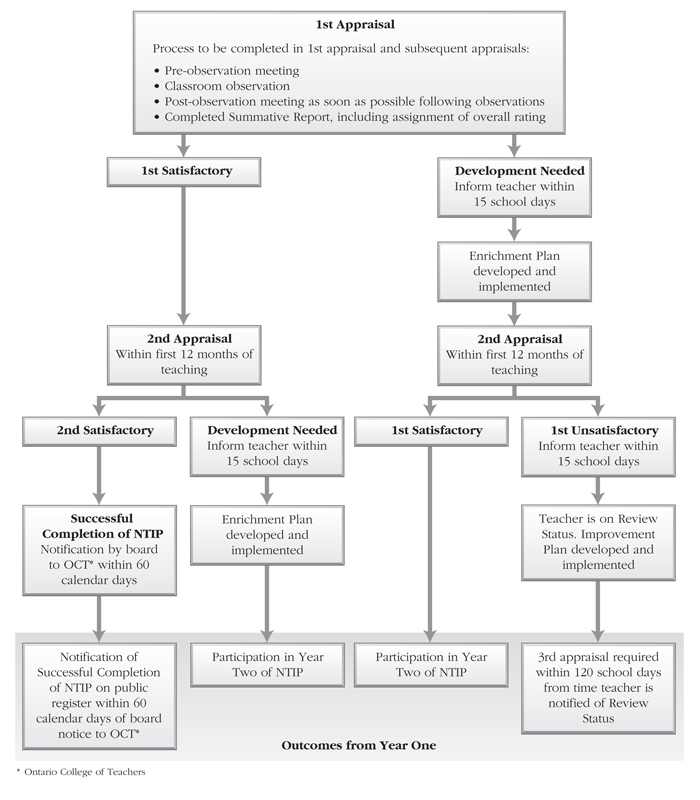
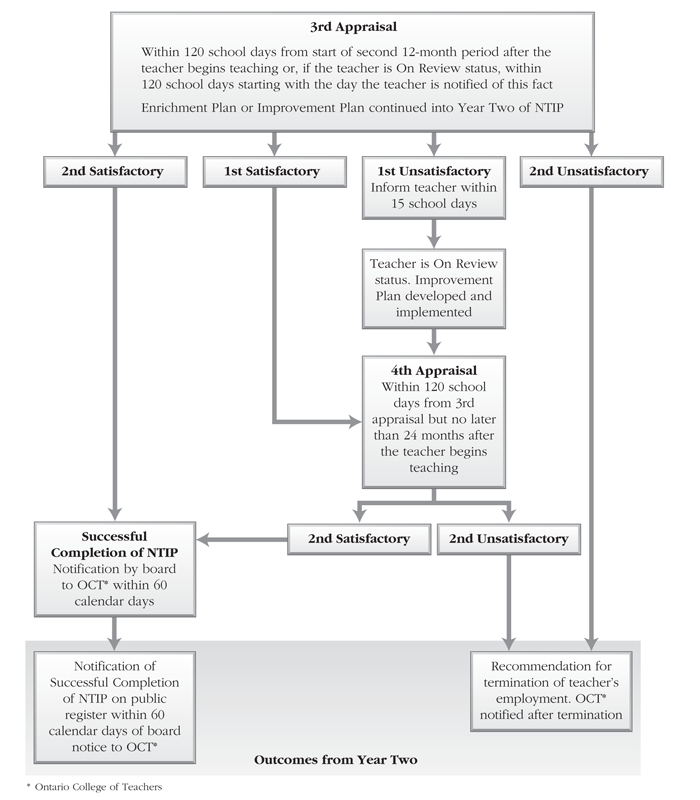
In instances where the NTIP appraisal process results in a performance rating that is satisfactory, a second appraisal must occur within the first 12 months of teaching. When the teacher obtains two satisfactory appraisals, they have successfully completed NTIP and a report must be rendered to the OCT. Where a first appraisal results in a rating of Development Needed, an enrichment plan must be developed and implemented. A subsequent Unsatisfactory rating will place the teacher On Review Status, and a third appraisal will be required.

For more information refer to Ministry of Education – New Teacher Induction Program (www.edu.gov.on.ca)


2. Key Components of the Performance Appraisal Framework for New Teachers

The key components of the performance appraisal framework for new teachers are:

  • Competency statements to focus the appraisal on the immediate skills, knowledge and attitudes that new teachers require to meet the Ontario College of Teacher’s Standards of Practice for the Teaching Profession.
  • Appraisal meetings that promote professional dialogue between the principal and teacher. A principal must arrange a pre-observation meeting with the teacher in preparation for the classroom observation and a post-observation meeting after the classroom observation. The meetings provide opportunities for reflection and collaboration to promote growth and improvement:
  • A summative report to document the appraisal process, which becomes a vehicle for teachers to reflect on the feedback they receive and to monitor their own growth. The Summative Report Form for New Teachers is an approved form in accordance with the Education Act that provides a consistent approach to documenting the appraisal process.
  • A rating scale and rubric to assess new teachers’ overall performance and provide necessary feedback about strengths and areas for growth. The scale for new teachers is
    • Satisfactory
    • Unsatisfactory
    For a teacher who receives a Development Needed performance rating, the scale in subsequent appraisals is
    • Satisfactory
    • Unsatisfactory
    The rubric describes evidence of teaching performance at each level of the scale for each competency.
  • A process for providing additional support depending on the outcomes of the appraisal.

3. New Teacher Induction Program (NTIP): Performance Appraisal of New Teachers Flow Chart

NTIP Year One (Two appraisals are required in the first 12 months after the teacher begins teaching)
NTIP Year Two – If Required
(Must be completed within the teacher’s first 24 months of teaching)
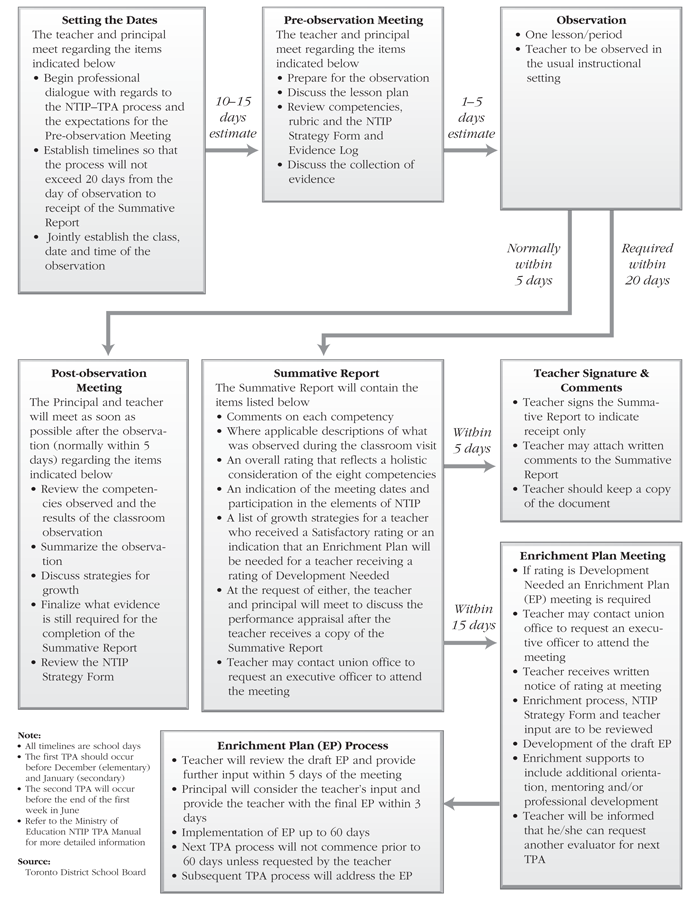
4 (a). NTIP New Teacher – TPA Timeline Chart (Satisfactory)
Note:

  • All timelines are school days
  • The first TPA should occur before December (elementary) and January (secondary)
  • The second TPA will occur before the end of the first week in June
  • Refer to the Ministry of Education NTIP TPA Manual for more detailed information

Source:
Toronto District School Board

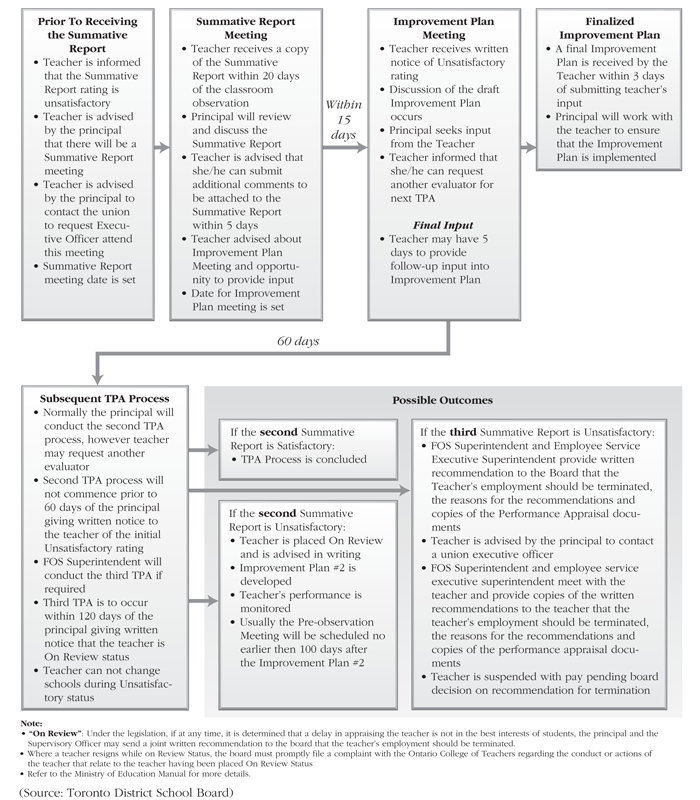
4 (b). NTIP New Teacher – TPA Timeline Chart (Unsatisfactory – “On Review”)
5. Individual NTIP Strategy Form
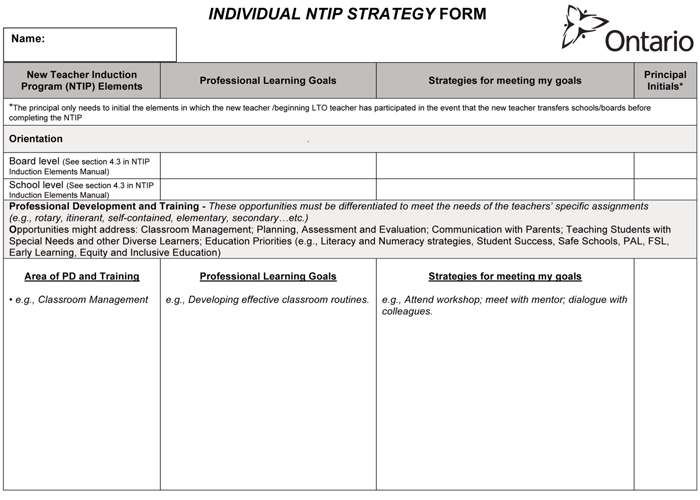
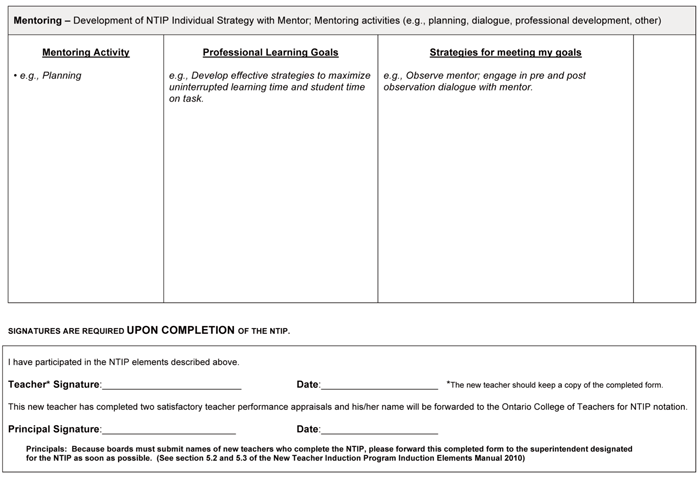
The Individual NTIP Strategy Form

The Individual NTIP Strategy (INS) form is intended to serve as a vehicle for discussion and learning, as well as a means of planning, tracking, and recording the NTIP induction elements in which each new teacher participates. It contains no evaluative elements and is intended as a tool to reflect completion of the NTIP individualized program. This form is not a checklist. The program requires that the Individual NTIP Strategy form be used. Please refer to the on-line appendices at http://faab.edu.gov.on.ca/NTIP.htm for the current year’s form.

The New Teacher Induction Program (NTIP) requires that the Individual NTIP Strategy form be used. The following chart summarizes the process.

Principal New Teacher Beginning LTO Teacher* Mentor
  • as part of school level orientation, the principal will provide information on the elements of NTIP: orientation, professional development and training, mentoring, and the TPA for new teachers
  • the principal gives the Individual NTIP Strategy form to the new teacher and indicates that this is the form to be used to record and track supports needed in each of the NTIP elements (excluding TPA)
  • the principal, based on the definition of new teacher in the NTIP: Induction Elements Manual (2008), communicates to the new teacher the elements in which he/she needs to participate
  • the principal lets the new teacher know that the mentor can collaborate with him/her on the completion of the form and that once they have discussed needs and planned strategies, the new teacher will then share the plan with the principal so that the he/she can approve and allocate the appropriate resources
  • the principal does not evaluate the NTIP Individual Strategy Form or Induction elements
  • the principal, as catalyst in the new teacher’s professional growth, through collaborative leadership, has an ongoing role in monitoring progress and reallocating resources as needed throughout the year
  • the principal records on the Summative Report Form for New Teachers the NTIP induction elements in which the new teacher has participated/is participating (as previously communicated to the teacher by the principal based on the definition of “new teacher” in the NTIP: Induction Elements Manual, 2010).
  • once the new teacher has received two Satisfactory ratings on performance appraisals for new teachers, the principal signs the form to indicate that the NTIP has been completed
  • as part of school level orientation, the new teacher receives information on the NTIP: orientation, professional development and training, mentoring, and the TPA for new teachers
  • the new teacher receives the NTIP form from the principal along with an explanation of its use
  • the new teacher is responsible for the Individual NTIP Strategy form
  • once the new teacher understands which category he/she is in and in which elements he/she must participate, the new teacher collaborates with the mentor and principal (or others as needed) to determine what participation in those elements will look like including topics, strategies, timelines etc. (excludes TPA). Once ready the new teacher shares the plan with the principal so that the principal can approve and allocate the appropriate resources
  • the new teacher continues to collaborate with the mentor to work through the plan, making adjustments if necessary
  • the new teacher is in conversation on an on-going basis with the principal and mentor as they progress through the plan
  • the new teacher signs the form once participation in the NTIP induction elements has been completed
  • as part of school level orientation, the beginning LTO teacher receives information on the NTIP: orientation, professional development and training, mentoring, and evaluation processes (if applicable)
  • the beginning LTO teacher receives the NTIP form from the principal along with an explanation of its use
  • the beginning LTO teacher is responsible for the Individual NTIP Strategy form
  • once the beginning LTO teacher understands which category he/she is in and in which elements he/she must participate, the beginning LTO teacher collaborates with the mentor and principal (or others as needed) to determine what participation in those elements will look like including topics, strategies, timelines etc. (excludes TPA). Once ready the beginning LTO teacher shares the plan with the principal so that the principal can approve and allocate the appropriate resources
  • the beginning LTO teacher continues to collaborate with the mentor to work through the plan, making adjustments if necessary
  • the beginning LTO teacher is in conversation on an ongoing basis with the principal and mentor as they progress through the plan

*Beginning full-time continuing education teachers who are participating in the induction elements of NTIP should also use the INS Form.

  • as part of mentor training, the mentor receives information on the NTIP: orientation, professional development and training, and mentoring
  • the mentor works in consultation and collaboration with the new teacher or the beginning LTO teacher to determine what participation in the elements will look like including topics, strategies, timelines, etc.
  • the mentor meets with the new teacher or the beginning LTO teacher to work through the plan, suggesting adjustments if necessary
  • the mentor continues to collaborate with the new teacher or the beginning LTO teacher to work through the plan, suggesting adjustments if necessary

6. NTIP: A Checklist for Principals

Review New Teacher Induction Program: Induction Elements Manual, 2010

Meet with new teachers when they are hired or assigned to the school to discuss the Individual NTIP Strategy Form (available at http://faab.edu.gov.on.ca/NTIP.htm) and to communicate to the new teacher those induction elements in which he or she is required to participate, based on the definition of “new teacher” and requirements related to participation in the NTIP and in accordance with O. Reg. 266/06.

Ensure that each new teacher, in consultation with his or her mentor, fills out the Individual NTIP Strategy Form, and ensure that the strategy is revised throughout the year as the needs of the individual new teacher change.

Ensure implementation of school-based supports (orientation, mentoring and professional development and training) for new teachers.

Ensure that mentors are recruited, selected and matched according to the board process developed by the NTIP Steering Committee.

Ensure that mentors receive training (this may be carried out through board-level activities where appropriate).

Work with the designated NTIP superintendent and other principals regarding system-wide sessions where these are more appropriate.

Conduct performance appraisals for each new teacher in accordance with the requirements of the performance appraisal process for new teachers set out in the Education Act and accompanying Regulations and Guidelines, and in conjunction with any additional requirement established by your board. Principals should refer to the Teacher Performance Appraisal: Technical Requirements Manual.

Sign each new teacher’s Individual NTIP Strategy Form and forward a copy to the designated NTIP superintendent when the teacher has received a second Satisfactory performance ratings. This will indicate to the board that these new teachers are eligible for the notation of successful completion on their Certificate of Qualification.